

Around 1681, Jean-Baptiste Colbert, Louis XIV’s Controller-General of Finances, met with a group of French merchants suffering from British and Dutch competition. Colbert would give his name to a doctrine, Colbertism: royal manufactures, high tariffs, guilds regulated down to the width of a cloth, and state control over industry. Eager to boost commerce, he asked them, in good faith, what the Crown could do to help their business. One of them, a merchant named Le Gendre, answered without hesitation:
“Laissez-nous faire, vous nous avez suffisamment aidés” – “Let us be; you have helped us enough already.”
The phrase outlived both men. The Marquis d’Argenson put it in print in 1751, Turgot retold it in his eulogy of Vincent de Gournay, and the Physiocrats forged it into a doctrine: laissez faire, laissez passer. It crossed the Channel and became the motto of the liberal order that made the West rich.
More than three centuries later, not much has changed in France, except that the merchants have stopped asking to be left alone: they now welcome interventionism. Laissez-faire is both a French expression and a French anathema. The country remains centralized around a nanny state impervious to basic economics and unable to resist its natural impulse to intervene. And whenever its help fails, France asks for more of it.
The “Student Protests” in France: mistaking the poison for the cure
“God laughs at men who deplore the effects whose causes they cherish.” – Bossuet
The latest illustration is unfolding in the streets. Since mid-September, high-school and then university students, backed by teachers’ unions, have blockaded hundreds of schools, denouncing crumbling buildings, overcrowded classes, absent teachers who are never replaced, and a chronic lack of funding.
They are right about the symptoms, wrong about the diagnosis.
As with healthcare, France runs a free, centrally planned education system, and money is not what it lacks: the nation spends €11,140 a year per pupil or student, 4.5% more than the OECD average and nearly twice as much, in real terms, as in 1980. National Education is still the largest line in the State budget, at €89 billion for 2027 – up again, even as schools lose 180,000 pupils – but 32% of it pays the pensions of retired civil servants, through the very pay-as-you-go system we describe below.
Nor does the money go where the protesters think. High-school buildings belong to the regions, not to the ministry. Teachers, meanwhile, are underpaid by international standards – fifteen years into the job, a collège teacher earns 18% less than the OECD average – and their classes too often go untaught: in 2023-24, 9% of class hours in public collèges, 10.3 million hours, were never delivered, a good part of them lost to training sessions, meetings and exams organized by the system itself. As for equipment, beyond €40,000 of spending, schools and local authorities must run a tender or go through a central purchasing body, so in practice they order from the catalogs of a few approved suppliers, at prices often two to four times the market price.
Molière, who wrote for the same king Colbert served, never tired of mocking the doctors of his day, who bled their patients to purge them of their “bad blood”. When the patient grew weaker, they did not question the remedy; they bled him again. The protesters are no different: French schools are dying of too much state intervention and wasted public money, yet they ask for more, convinced that, in a larger dose, the poison will magically become the cure.
All within the state, nothing outside the state, nothing against the state
“France is an extremely fertile country: plant civil servants, and taxes grow.” – Georges Clemenceau
Schools are only one example. In France, every problem calls for a plan, every plan for an agency, and every agency for a new levy. Today, public spending accounts for more than 57% of GDP, outpacing the USSR’s at its peak, and France’s taxes and compulsory levies are the highest in the G20. One French worker in five is employed by the state, the highest share in the G7: Scandinavian levels of public payroll, without Scandinavian levels of trust or efficiency. France’s “Colbertist” culture of norms, codes, regulations, and state intervention continues to undermine its economic development to this day.
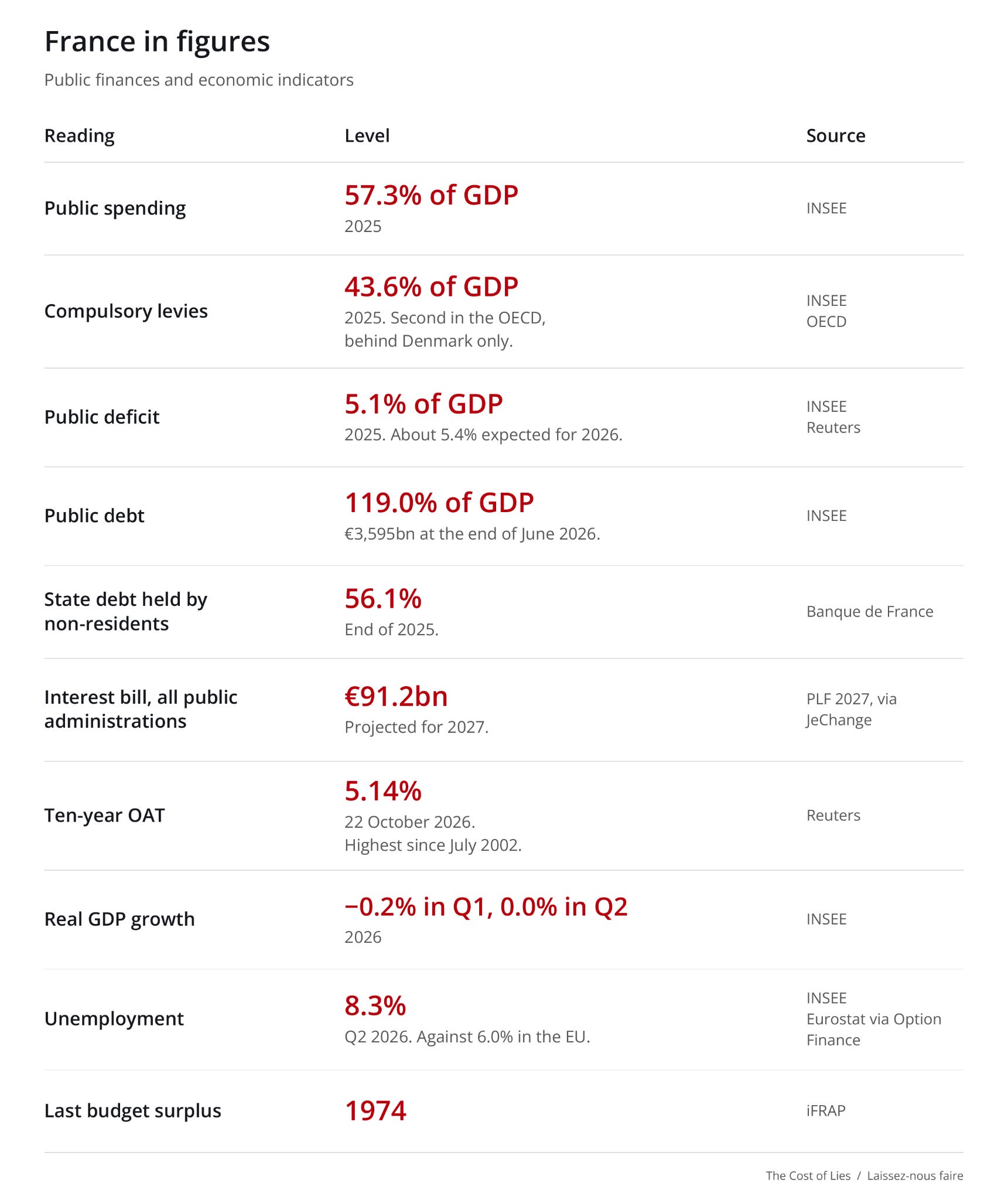
Every line of this table tells the same story: for decades, France has been living beyond its means by mortgaging its future – the very “illusion of prosperity” we described in our manifesto. It was not always so.
After WWII, France largely espoused Colbert’s ideas. Under de Gaulle and Pompidou, the country invested heavily in capital goods (think infrastructure) through public enterprises and large public-private partnerships: it launched the Plan Calcul in computing and pioneered nuclear power generation, high-speed trains, supersonic airliners (Concorde), space programs, telecommunication networks, state-of-the-art fighter jets (the Mirage, and later the Rafale), as well as nuclear submarines and aircraft carriers. As with any central planning, this was not sustainable1, but it nonetheless created a rich and productive capital stock, i.e., wealth. Those years matter, because they convinced France’s large boomer generation that central planning and Keynesianism were the panacea for economic development.
From the mid-1970s onward, however, the nature of public spending changed: investment gradually shrank, while the state’s balance sheet was increasingly used to support consumption. With no incentive to maintain, adapt, and lengthen it, the capital stock slowly eroded and was consumed to compensate for France’s genuine lack of productivity, itself largely due to overregulation, excessive public spending, and fewer hours worked over fewer years. Put differently, France was a very wealthy country thanks to its strategic assets, high-tech industries, productive infrastructure and highly educated workforce, and all this wealth allowed a generation to live beyond its means.
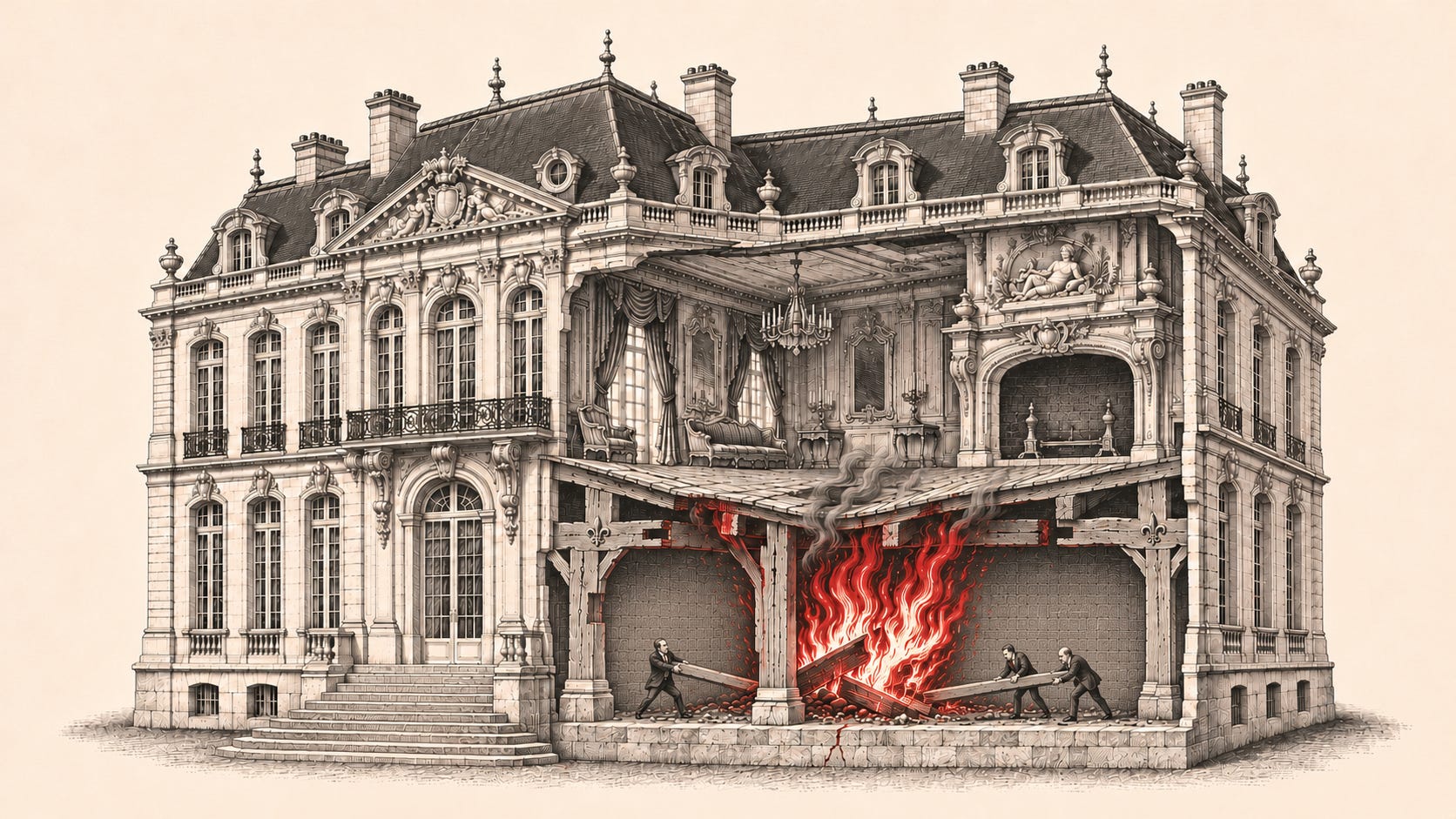
Now, France has both a stock and a flow problem: its capital stock has been partly depleted and partly transferred to foreigners, and with it, the flows it used to produce. The boomers who lived through the golden age of the Trente Glorieuses are completely out of touch with reality. Unable to see that their way of life was financed by wealth destruction and reckless borrowing, they are like those penniless aristocrats who keep the fire going with the castle’s own beams, and never wonder why the roof is sagging.
Self-inflicted poverty: France’s pension system
“The problem with socialism is that one eventually runs out of others’ people money” – Margaret Thatcher
Nowhere is the roof sagging faster than in the pension system, which shows better than anything the cost of France’s idiosyncratic socialist mindset, and the generational divide it creates. Since the end of WWII, France has operated a pay-as-you-go public pension system. Such a system seemed sustainable during the Trente Glorieuses, when high productivity, full employment, and a ratio of four workers per retiree were the norm. It even felt humane and generous: a country built upon intergenerational solidarity, where the healthy and the young support the old and the sick, creating a national brotherhood renewed with each generation.
Over the last 40 years, however, each generation has negotiated its pension at the expense of the next, in a system incapable of adapting to demographic and economic change. This generational Ponzi scheme, through which the equivalent of Denmark’s GDP is transferred every year from the working population to retirees – including the 32% of the education budget that never reaches a classroom – can be summed up in a single sentence: “Paiera bien qui naîtra le dernier” – “He who is born last pays most.” As a consequence, French retirees are among the very few in the developed world, alongside Italians and Luxembourgers, whose average income matches or exceeds that of the population as a whole.
“Demography is destiny,” the French philosopher Auguste Comte famously said, to which we would add: “especially in a fiat-based democracy.” Although any 15-year-old could see how unsustainable France’s pension system is, it has proven impossible to reform. French boomers control both the land and the state: their numbers secured them the spoils of democracy, and their date of birth allowed them to take control of most of the country’s private assets – mostly real estate, by riding fiat inflation (the Cantillon effect) – while leaving their children an enormous pile of debt, a country on the brink of civil war, and a communist economy in shambles. Merci Papa.
Little of what we have described is specific to France, and we expect most of our readers to recognize patterns from their own country in this portrait. What makes France unique is the degree of this economic madness.
In essence, lies were told for the better part of five decades, and now the debt to the truth has to be paid. It will be paid over years, if not decades, by millennials.
Live by French Socialism, die by French Socialism: the downfall of the euro
“The exchange rate is the catch-basin for unearned rights” – Jacques Rueff
Outside a monetary union, that debt would have been called in long ago, by the currency: as Rueff saw, the exchange rate is where a nation ends up paying for the rights it never earned. The euro was designed to silence that messenger. The French socialists under Jacques Delors and François Mitterrand wanted a way to carry out their agenda without foreign-exchange markets reminding them of economic reality. They leveraged the fall of the Berlin Wall and German reunification to create the euro. Mitterrand famously said: “I nailed Germany’s hands to the table of the euro.” Locking the exchange rate between France and Germany would socialize deficits and surpluses, thereby allowing French socialists to spend more without having to devalue.
The fixed exchange rate between France and the other eurozone countries led to capital misallocation on an unprecedented scale: too many civil servants and rentiers in France, too many factories in Germany. France’s economy now rests on an artificially high exchange rate, Germany’s on an artificially low one. Under floating exchange rates, France’s profligacy would have triggered devaluations, curbing imports and making exporters competitive again, thereby rebalancing trade and capital flows. Conversely, Germany’s competitiveness would have generated trade surpluses and currency appreciation, forcing it to move toward higher value-added industrial products. Instead, the fixed exchange rate perpetuates a trade imbalance offset by capital inflows: chiefly foreign purchases of French debt (non-residents now hold 56% of the State’s debt) and, to a lesser extent, TARGET2 balances – at the end of 2025, the Bundesbank held a claim of about €1 trillion on the Eurosystem, while the Banque de France owed it about €200 billion.
In other words, French industry subsidizes a kind of permanent competitive devaluation for German industrialists, while Germany subsidizes the expansion of the French welfare state and its bureaucracy.
But this structural imbalance would seal the fate of the single currency. With too many factories in Germany, too many civil servants in France, and no mechanism to restore balance, France’s creature could only lead it to bankruptcy: France is simply too big to be bailed out as Greece was, and its imminent debt crisis will most likely spell the end of the euro.
In Search of Capital Lost
“Nothing is lost, nothing is created, everything is transformed.” – Antoine Lavoisier
How, then, will France react when the bill comes due? Of the five ways out of a debt crisis listed in our manifesto, growth, the only painless one, is off the table: France’s private sector carries a very large and expensive stock of debt. Unlike Portugal, Spain or Greece, France was never forced into austerity during the eurozone crisis of the early 2010s, and so avoided the structural reforms it needed. Instead, it kept borrowing heavily through the years of zero interest rates to make up for its lack of productivity. With private-sector debt above 220% of GDP, and debt service swallowing 20% of its income every year, France has no chance of growing its way out of this crisis.2
With ten-year borrowing costs near their highest since 2002, riots in the streets and a presidential election less than six months away, four options remain, each a different answer to the same question: who pays?
Option 1: a German or IMF bailout, and austerity. Greece needed three bailouts, the largest in history, for a debt one-tenth the size of France’s. The European Stability Mechanism can lend at most €500 billion, barely a seventh of what France owes, and its own credit rests on its second-largest shareholder: France. The IMF’s entire lending capacity, about a trillion dollars, would cover a quarter. Germany, already borrowing to rearm, will not underwrite French pensions. Only the ECB has unlimited firepower, but its Transmission Protection Instrument is reserved for countries that respect the EU’s fiscal rules – France has been under an excessive deficit procedure since 2024 – and its older Outright Monetary Transactions require an ESM programme. Whoever lends, the money will come with austerity written in Brussels and Frankfurt: lower pensions, fewer civil servants, higher taxes. A country that suspended a two-year rise in the retirement age to keep a government alive will not welcome a troika in Bercy. In France, austerity has always ended in the streets.
Option 2: devaluation/inflation. For most of the twentieth century, France settled its accounts by devaluing the franc, again and again. The euro took that lever away, which was precisely the point. Devaluation is still possible, but only through the back door: the ECB buys French bonds and debases the euro for 350 million Europeans so that 68 million French can keep their pensions. In that case, German and Dutch savers would end up footing the bill, and with nationalists on the rise across the Rhein, they are unlikely to accept this.
Option 3: Financial repression. French households hold €2,162 billion in life insurance, about a quarter of it in government bonds, and since the Sapin II law, as noted in our manifesto, the State can temporarily lock the door. Rates held below inflation would erode the debt, and with it the savings of those who trusted the State. The other half of the bill is credit deflation: banks and insurers stuffed with government paper lend less to everyone else, property prices inflated by decades of cheap credit deflate, and the losses fall on the young, who borrowed heavily to buy their homes from their parents. He who is born last pays most.
Option 4: default and the end of the euro. The last option is as much part of French history as cuisine and wines are. Reinhart and Rogoff count eight French defaults between 1558 and 1788, one of them in 1661, the year Colbert took charge of the King’s finances; John Law’s paper money ended in bankruptcy in 1720; and after the assignats, the Directory repudiated two-thirds of the public debt in 1797. A modern default would be quieter. Nearly all French government bonds are governed by French law, so a government could redenominate them by statute into new francs and let the new currency sink: a default in all but name, borne largely by the foreign creditors who hold most of it. For a government elected to defy Brussels and the markets, the temptation would be real. But the euro would not survive the departure of its second-largest economy, and French banks and savers would see their claims converted into francs worth a fraction of their face value.
“You have helped us enough”
Four options, then, and one constant: whichever path France takes, the bill will be paid by those who saved, those who work, and those who were born last. The State will not choose; it will do what it has done since Colbert – plan, intervene, and levy to buy time – until the choice is made for it, by its creditors or by its streets.
Which is why the only sensible reply to the State’s offer of help is still Le Gendre’s: laissez-nous faire. In 1681, a merchant could only ask the minister to step aside, and Molière’s patients could only submit to another bleeding. In 2026, savers no longer need anyone’s permission: bitcoin held in self-custody cannot be debased by a central bank, redenominated by statute, or frozen by a council chaired by the Minister of the Economy.
In Choses vues, Victor Hugo wrote: “Providence has willed that there has always been something great at the head of France. Under the Old Regime, it was a king; under the Empire, a man; under the Republic, an assembly.” An avid student of History, the French writer knew all too well his country’s unique tendency to collapse and then come back from nowhere. Perhaps it can do it yet another time, but this time, Providence would have to put something greater still at its head: freedom.
Economic Calculation in the Socialist Commonwealth, Ludwig von Mises (1920).
Bank of International Settlements. Private non-financial sector, debt service ratios.
Très intéressant, un travail remarquable n’étant pas à la hauteur, j’utilise l’intelligence artificielle pour m’aider à comprendre chaque chapitre, Pour moi, c’est comme un décryptage de la complexité de L’infrastructure